
Better Materials.
Lower Impact.
Real Manufacturing Responsibility.
The Plastic Card Problem
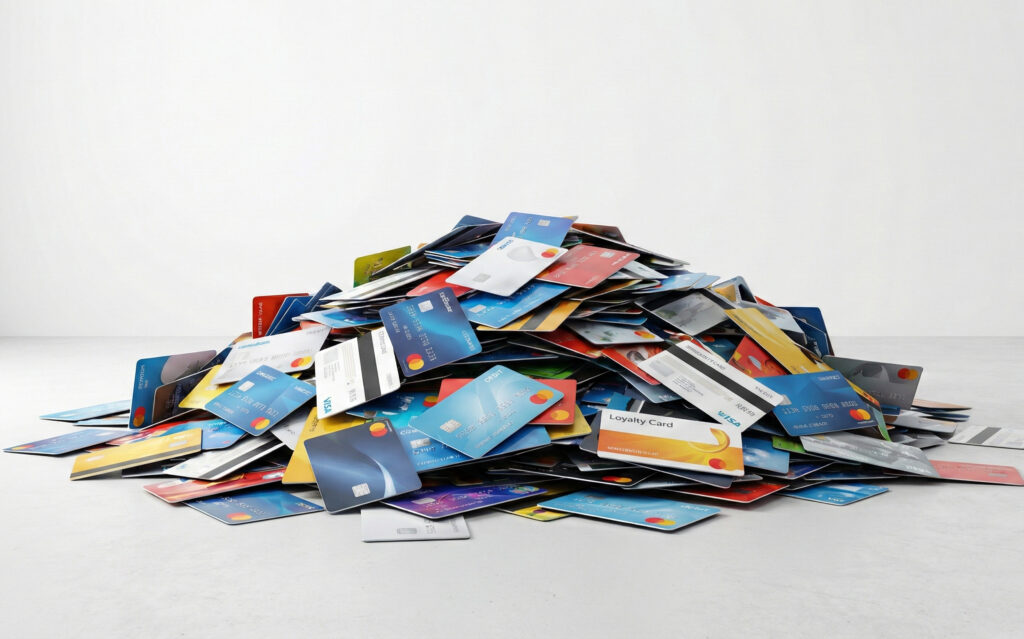
Every year, the world produces 30 billion plastic cards. That’s 15,000 tons of plastic waste.
Most are used for only 6–24 months, yet remain in the environment for centuries.
This is the challenge facing our industry.
And it is why material innovation and responsible manufacturing matter.
Our Sustainability Story
Card production generates thousands of tonnes of short-lifecycle plastic every year.Most cards are used for 6–24 months — but the PVC behind them lasts centuries.
We built our sustainable material platform to change this equation:
repurposing industrial PVC waste, expanding paperboard alternatives, and reducing process waste at the factory level.
Our goal is simple:
Less plastic. Longer-lasting materials. Cleaner manufacturing.
The “ForNext Print Model”
Why Direct-from-Factory Is the Greener Choice
Traditional card supply chains involve multiple intermediaries: middlemen, consolidators, regional distributors — each adding repackaging, extra logistics legs and avoidable emissions.
The ForNext Model is different.
With UK-based project management and a single, ISO-certified production source, each order follows one optimised route rather than three or four fragmented ones.
By consolidating batch production and offering split-delivery options to reduce air freight dependency,
we minimise packaging waste, eliminate duplicate handling and significantly cut logistics-related CO₂.
Fewer steps. Fewer miles. Lower impact.
Recycling begins where most waste is created — inside the factory.

Recycled PVC
More than 70% of PVC waste in the card industry is generated before a single card is made:
- off-cuts, trims, test sheets and alignment pieces.
We work with certified recyclers who recover this material before it becomes waste.
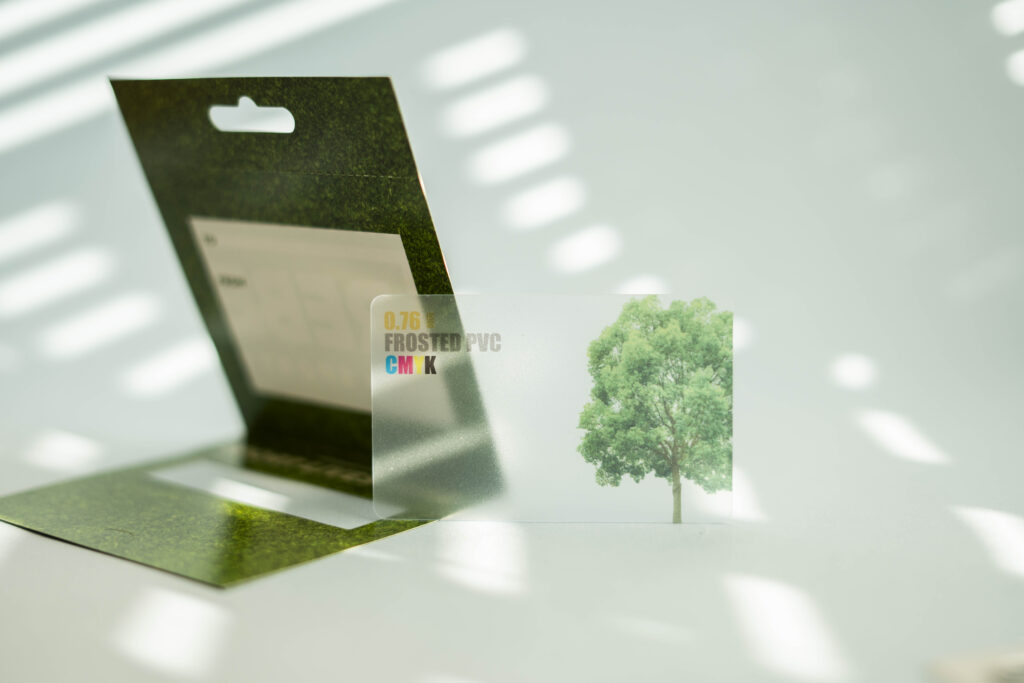
It is processed into post-industrial recycled PVC, a card-grade substrate that reduces carbon emissions
Up to 1.6 tonnes of CO₂ saved per tonne of RPVC
Around 40% lower energy use vs. virgin PVC
70–90% less landfill waste
FSC Paper
Every FSC card begins with fibre sourced from responsibly managed forests,
where harvesting follows strict rotation cycles and replanting is a structural requirement,
not an optional initiative.
We work with FSC-certified Chinese paper mills whose supply chains are independently audited.
This gives our paperboard cards a credible, internationally recognised sustainability foundation – with full chain-of-custody documentation through our suppliers.
According to the EU PEF (Product Environmental Footprint) benchmarks:
- FSC paperboard emits 0.9–1.2 kg CO₂ / kg
- Virgin PVC emits 2.7–3.5 kg CO₂ / kg
➡️ Paper cards reduce carbon emissions by up to 65% versus equivalent PVC card stock.
A Responsible, Plastic-Free Alternative

Renewable Materials, Crafted with Precision
Wood Cards
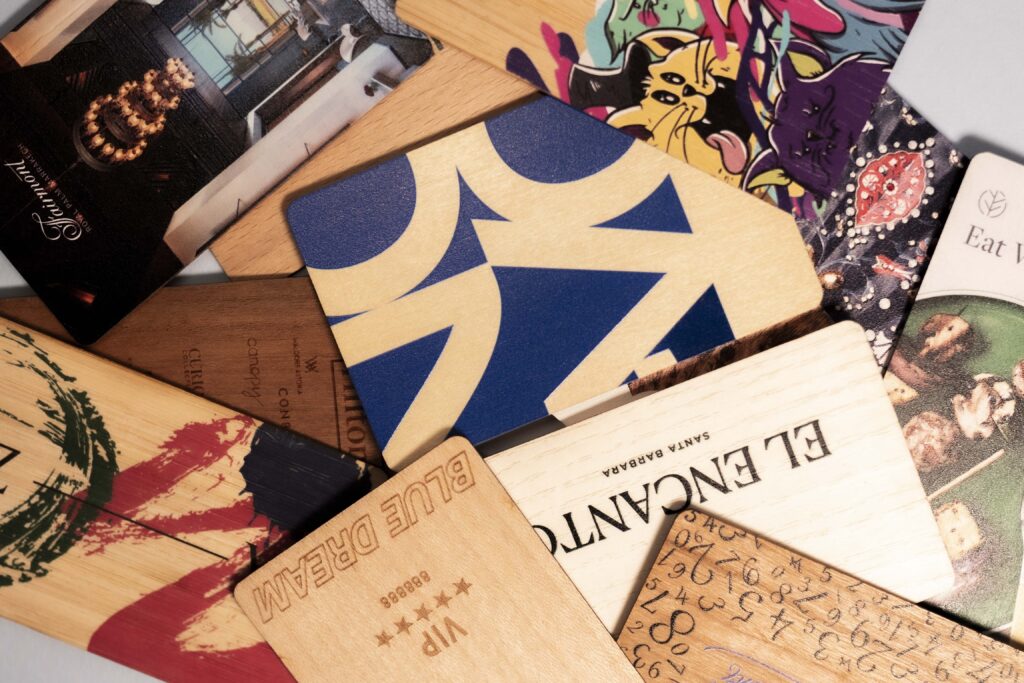
Our wood cards begin as responsibly sourced hardwood veneers,
processed from managed forests that operate with renewal cycles –
meaning trees are harvested only at sustainable rates and constantly replanted.
Each veneer sheet is cut, stabilised and laminated into thin, resilient card-grade layers.
The natural grain means no two cards are truly identical – a detail valued in premium hospitality and membership programmes.
Laser engraving minimises waste, producing intricate designs without excess material loss and giving each card a distinct, tactile identity.
Wood cards have 70–85% lower lifecycle carbon emissions than PVC
Wood is renewable and biodegradable
Processing produces no microplastics
Veneer waste can be reprocessed or used as biomass
Low-Waste Manufacturing
Efficiency as an Environmental Discipline
Most waste in card production comes from sheet trimming, lamination alignment, colour calibration and die-cutting.
Our production lines are designed to minimise these losses – optimising sheet layouts, reusing setup sheets where possible, and continuously measuring cutting accuracy to reduce off-cuts.
By controlling the process end-to-end (printing → lamination → encoding → cutting), we can reduce waste not just per batch, but across the entire production ecosystem.
28–35% reduction in PVC/Paper off-cuts
18–22% reduction in lamination waste
>60% improvement in cutting accuracy
Setup sheets reused in test cycles → fewer disposals
Better colour profiling reduces misprints and re-runs